
Sub-Slab Depressurization for Upstate Homes
The most common way to lower radon in slab and basement homes. We install clean, quiet systems across Greenville, Spartanburg and Anderson, typically in a few hours to a day.
Get a Free Quote Call (727) 300-6656The problem: radon pulled up through the slab
Radon comes from the soil under your home. Houses tend to have slightly lower air pressure inside than in the ground below, especially when the heat is running or exhaust fans are on. That pressure difference pulls soil gas, radon included, up through cracks, joints, floor drains, sump pits and gaps around pipes.
Sealing cracks helps, but it rarely fixes the problem alone. Concrete moves, new cracks open, and there are always openings you can't reach. The EPA recommends fixing a home at 4 pCi/L or higher and suggests considering a fix between 2 and 4. If your test is in that zone and your home sits on a slab or basement, sub-slab depressurization is usually the answer.
How sub-slab depressurization works
Sub-slab depressurization, sometimes called active soil depressurization, flips the pressure difference. Instead of your house pulling radon in, a fan pulls it out from under the slab and vents it above the roofline, where it mixes into outdoor air.
- Suction pit: we drill a hole through the slab and remove some fill to open a small pit, which gives the fan a wide area to pull from.
- PVC pipe: sealed pipe runs from the pit up and out, either along the outside wall or through the interior to the attic.
- Radon fan: an in-line fan sized to your home, mounted outside the living space, runs continuously to keep the area under the slab at lower pressure.
- Manometer: a simple gauge on the pipe shows the system is pulling suction, so you can check it at a glance.
- Sealing: we seal major cracks, the pipe penetration and other key openings so the fan works efficiently.
The vent discharges above the roof edge and away from windows, so radon pulled out of the soil isn't drawn back inside.
Our install process
Review your test
We look at your radon result, or arrange a test if you don't have a recent one.
On-site assessment
We check the slab, the fill underneath, the sump if you have one, and the best pipe route inside or out. Some homes get a quick suction test to see how air moves under the slab.
Written quote
You get a clear written quote showing the system design, pipe route and price. No surprises on install day.
Install day
Most installs take a few hours to a day. We protect floors, keep dust down and clean up when we're done.
Post-install test
We test again after the system has run for at least 24 hours, so you have a result showing your levels dropped.
Typical cost
Our typical range for sub-slab depressurization on a slab or basement home is $900 to $2,500. Things that move the price include how many suction points the home needs, how tightly packed the soil is under the slab, whether there's a sump to seal, and whether the pipe runs outside or through finished space to the attic. Homes with both a basement or slab and a crawl space need a combination system, typically $2,200 to $3,800.
The fan typically costs about $30 to $300 per year in electricity, with most homes toward the low end. Every price is an estimate until we see the home in person.
See the full breakdown in our radon mitigation cost guide.
Why it matters in the Upstate
Greenville County is the only county in South Carolina that the EPA ranks Zone 1, its highest radon potential category, and state program data shows an average initial test of 3.4 pCi/L there, with readings as high as 126.6. Spartanburg, Anderson, Pickens and Oconee counties are Zone 2, and Oconee's average initial test of 5.0 pCi/L is above the EPA action level.
Many Upstate homes sit on crawl spaces or slabs, and older homes may have basements. Slab and basement homes are a natural fit for sub-slab depressurization. If part of your home is over a crawl space, see our crawl space radon mitigation page.
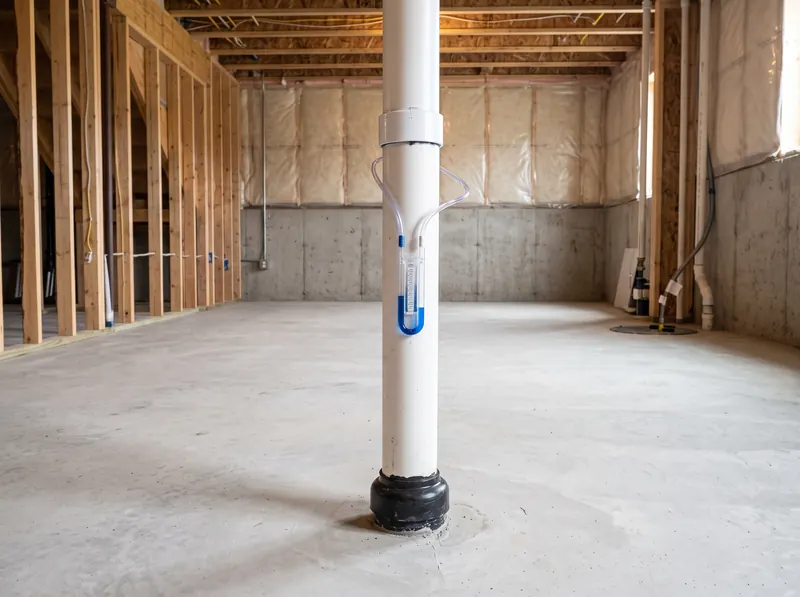
A clean, tidy install
A radon system lives on your house for years, so how it looks matters. We plan the pipe route with you, match it to your home where we can, and keep the run as short and straight as practical.
Choosing an installer? South Carolina doesn't have a state license for radon professionals, so it's smart to look for NRPP or AARST certification. We're happy to share the credentials of the technician assigned to your job.
Not sure if your number calls for a system? Start with radon testing.
Frequently asked questions
How long does a sub-slab depressurization install take?
Most installs take a few hours to a day. A simple slab or unfinished basement with a clear pipe route can be done in a morning. Homes that need interior routing through closets, finished space or an attic take longer. We'll give you a realistic time window on the written quote so you can plan your day.
How much does sub-slab depressurization cost?
Our typical range for a sub-slab depressurization system on a slab or basement home is $900 to $2,500. Where your home falls depends on the foundation, how well air moves under the slab, the number of suction points and the pipe route. Your final price comes from an on-site look, and it's always in writing first.
How much electricity does a radon fan use?
Radon fans run around the clock, so they do use some power. A typical fan costs about $30 to $300 per year to run, and most homes land toward the lower end of that range. We size the fan to your home so it moves enough air to lower radon without using more electricity than it needs to.
Will I hear the radon fan inside the house?
Usually not. The fan is mounted outside the living space, on an exterior wall or in the attic, so most homeowners hear little or nothing indoors. You may hear a soft hum standing right next to it outside. If an existing fan has become loud, that can be a sign of wear, and our system repair service can help.
How do I know the system is working?
Every system has a manometer, a U-tube gauge on the pipe that shows suction. If the liquid levels are uneven, the fan is pulling air. We also run a post-install radon test to confirm your levels dropped. The EPA suggests retesting every couple of years, and after major renovations, to make sure levels stay low.
Get a free sub-slab quote
Share your test result and a few details. We usually reply the same day.
Related services and areas we serve
Sub-slab systems are installed across the Upstate. Here's where to go next.
Related services
Nearby service areas
See every town we cover on our service areas page.
Know your number. Fix it if it's high.
Free radon mitigation quotes across the Upstate — usually a same-day reply.